Is it possible to track courses without an LMS?
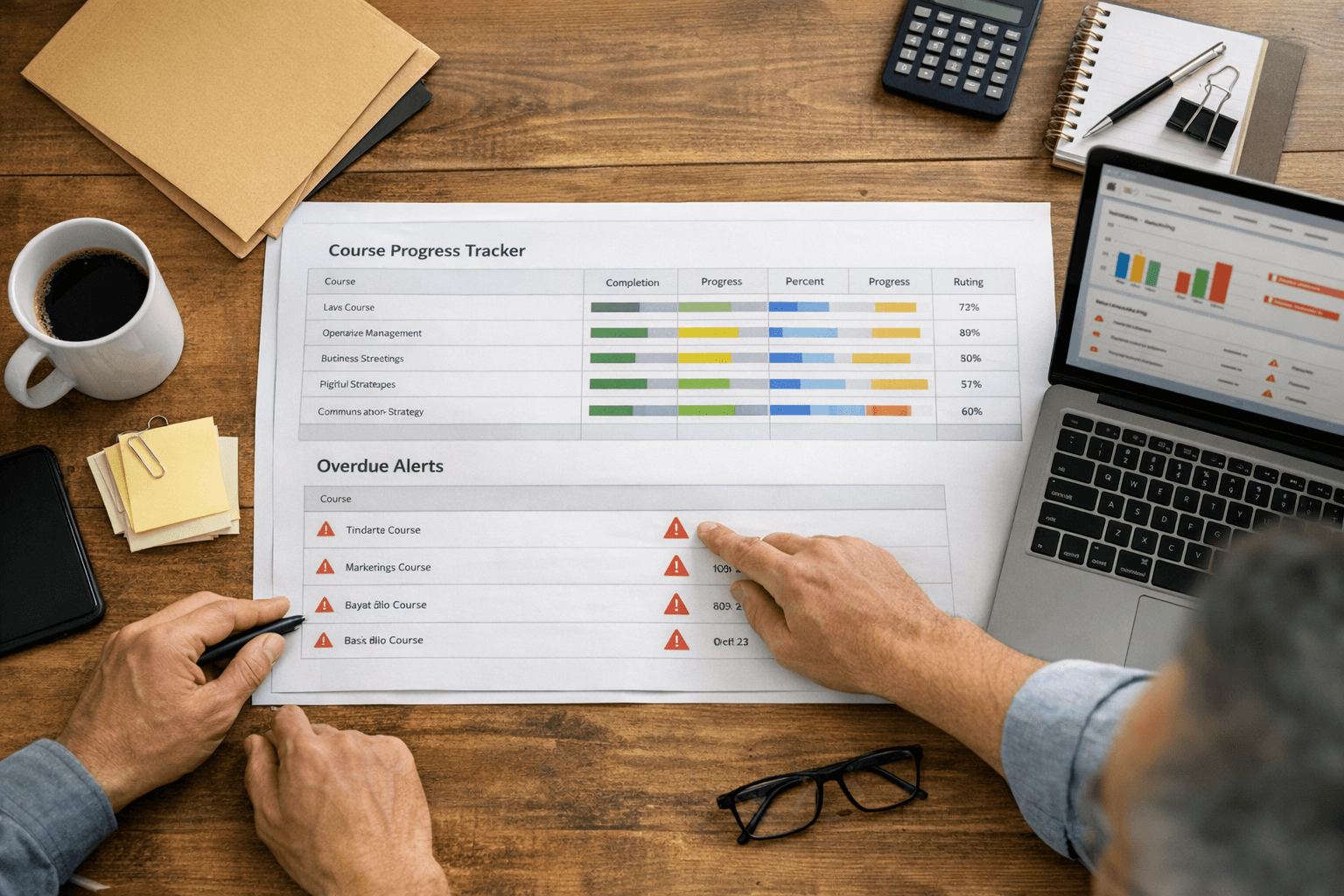
One of the main headaches for many SMEs is the lack of a training platform or LMS (Learning Management System) to manage and track their training. However, this does not mean you have to give up on training or measuring results.
Is it possible to track courses without an LMS?
One of the main headaches for many SMEs is the lack of a training platform or LMS (Learning Management System) to manage and track their training. However, this does not mean you have to give up on training or measuring results.
The good news is that there are simple, affordable, and effective ways to track courses without a traditional LMS. In this article, we will explore what these options are, their limitations, and how you can start applying these strategies in your organization today.
Why is it important to track courses?
Tracking is not just about knowing if a person completed a course. It is a fundamental part of the training cycle. It allows you to:
- Measure participation and progress of individuals.
- Evaluate understanding of the content.
- Collect data to justify decisions.
- Improve future versions of the course.
- Prepare for possible audits and legal compliance.
Options for tracking without an LMS
What options are available without an LMS?
Although an LMS remains the best tool for complete traceability, there are some alternatives for companies that do not have one:
1. Manual evaluation and attendance forms
Use Google Forms or Microsoft Forms at the beginning or end of each course to record:
- Attendance.
- Evaluation results.
- Feedback from participants.
Advantage: easy to implement. Disadvantage: requires manual consolidation and it is easy to lose traceability if the number of courses increases.
2. SCORM courses run on external platforms
Some e-learning courses can be exported in SCORM format and integrated into platforms like MoodleCloud or even free third-party LMS tools that provide limited tracking (for example, TalentLMS in its free version). Consider that OTICs also have LMS platforms that could be made available for the training processes of their affiliates.
Important: platforms like CoTraining allow you to download courses in SCORM format, but currently do not manage traceability directly, as it is a complementary tool to an LMS. Therefore, to obtain reports, the course needs to be uploaded to a compatible platform.
3. Tracking via email and direct supervision
In some cases, especially with small teams, tracking can be done by asking collaborators to send confirmation of course completion or evidence of final evaluation. This can also be done with supervisors who accompany the process.
Advantage: useful for specific training sessions. Disadvantage: not scalable and dependent on individual responsibility.
How does CoTraining help in this context?
At CoTraining, we understand that not all companies can implement a complete LMS. That’s why our platform allows:
- Create courses in minutes from a PDF or a title.
- Add evaluations, interactions, and multimedia content.
- Share courses via link or export them in SCORM.
This makes it possible to manage professional training without complex infrastructure.
Conclusion: starting without an LMS is possible
Not having an LMS should not be a barrier to training. There are tools and strategies that allow you to start, measure, and improve courses without significant investments.
Suggested next steps:
- Assess your current training needs.
- Choose tools that fit your volume and budget.
- Evaluate whether an LMS will be necessary in the future or if you can proceed without one.
Do you want to see how to create a course and share it via link or download it in SCORM? Try CoTraining and create your first course in minutes.
Ready to create courses with AI?
Try CoTraining for free and turn your documents into training in minutes.