
What is the SCORM format and why does it still matter?
Discover what the SCORM format is, how it works, and why it remains key for corporate e-learning in the age of AI.
What is the SCORM format and why does it still matter?
Discover what the SCORM format is, how it works, and why it remains key for corporate e-learning in the age of AI.
If you've ever downloaded a course in ".zip" format and uploaded it to an LMS, you've already worked with SCORM. Although the term may sound technical or outdated, the SCORM format remains the backbone of online learning in thousands of companies. In a world where AI, micro-courses, and interactive experiences are trending, SCORM is still there, ensuring that courses speak the same language as learning platforms. In this article, we will explore what SCORM is, why it remains relevant, and how it adapts to the future of corporate e-learning.
What is SCORM and how does it really work?
SCORM (Sharable Content Object Reference Model) was born in the early 2000s as a sort of "lingua franca" between online courses and LMS platforms. In simple terms, it allows a course created in one software (like Articulate or Captivate) to "understand" any LMS (like Moodle or SAP Learning).
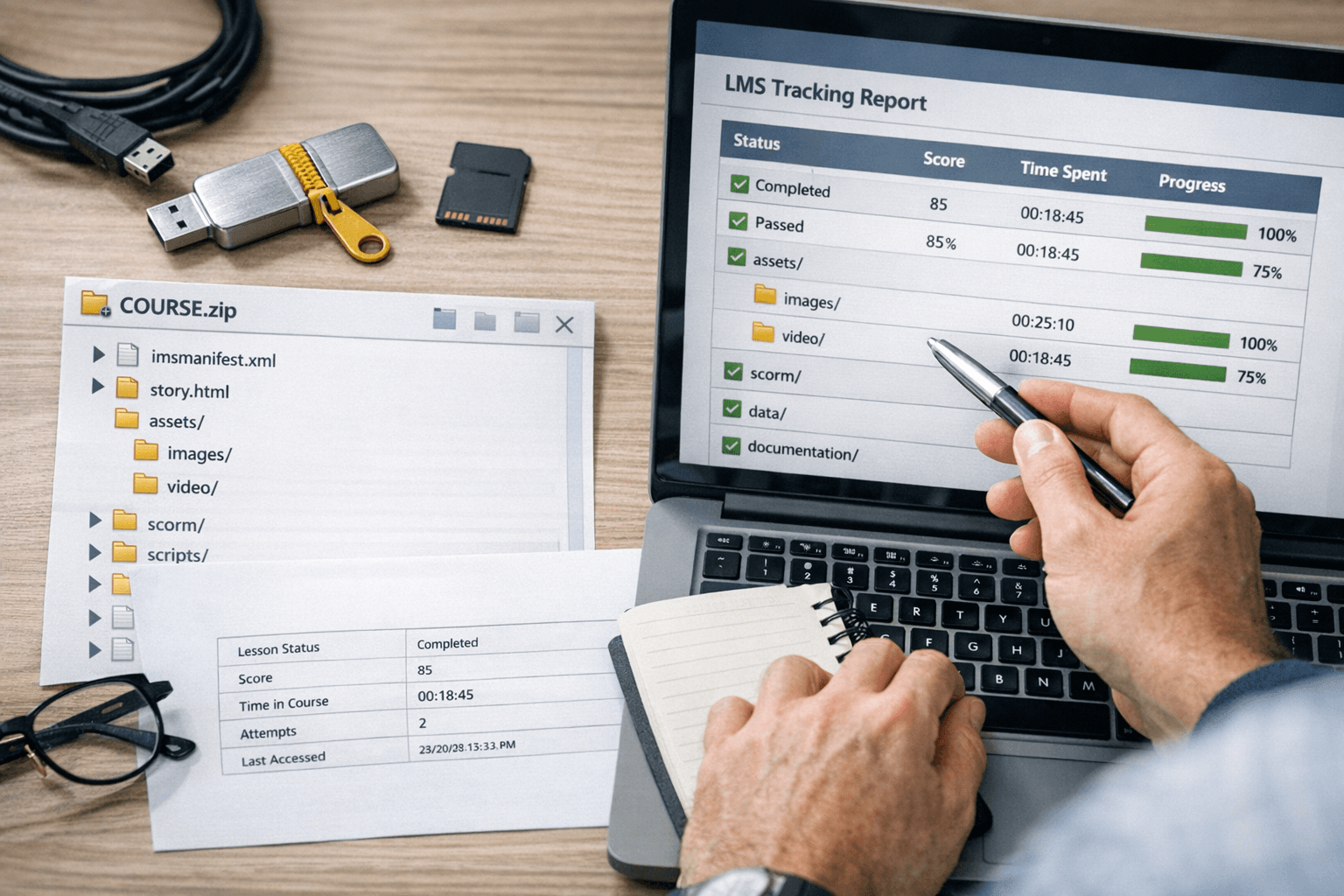
Imagine SCORM as a universal adapter: it packages your course in a .zip file with all the necessary information for the system to know what to display, how to track progress, and when to mark a course as completed. Without SCORM, each course would have its own language, and platforms wouldn't be able to read them correctly.
Although there are more modern alternatives today (like xAPI or cmi5), SCORM remains the most widely adopted standard in global corporate education.
Why SCORM still matters in 2025
You might think: "Aren't we already beyond SCORM?" Not quite. The reason is simple: compatibility. Almost all LMS platforms support it, and companies have invested millions in SCORM catalogs that continue to function seamlessly.
Additionally, SCORM:
- Tracks student progress and grades.
- Allows tracking without relying on constant internet access.
- Is easy to package, move, and version.
Even modern tools like CoTraining integrate SCORM exports, allowing teams to create courses with AI and then upload them to any LMS without complications. It's a way to combine the best of both worlds: today's automation with timeless interoperability.
Limitations of SCORM (and how to overcome them)
Of course, SCORM is not perfect. It does not measure experiences outside the LMS (for example, watching a video on YouTube or reading an article), and it does not collect advanced behavioral data. It was also not designed for mobile or micro-learning.
This is where newer standards like xAPI come into play, which track all kinds of experiences, and LRS (Learning Record Stores), which store richer data. However, the complete transition takes time, so SCORM remains the foundation upon which new solutions are built.
Many companies adopt a hybrid approach: maintaining their SCORM catalogs while starting to use modern tools like CoTraining, which facilitate the transition to more flexible formats without breaking compatibility with existing LMS platforms.
SCORM in the age of AI and automation
Today, creating a SCORM course doesn't have to be a technical or slow process. AI-powered platforms like CoTraining can automatically generate SCORM-ready content without relying on instructional designers or programmers. This means training teams can focus on what matters: content and the learning experience, not the format.
AI also allows for updating old courses into more dynamic and current versions, while maintaining the same SCORM file for the LMS. It's like giving new life to your resources without having to reinvent the entire training ecosystem.
Next steps
The SCORM format may seem like a digital relic, but its power remains enormous: it reliably connects courses, LMS, and learning data. In a corporate environment where interoperability is key, SCORM is the silent glue that holds everything together. The good news: with tools like CoTraining, you can continue using SCORM without sacrificing innovation or agility.
Explore how CoTraining combines AI and SCORM compatibility to make course creation as easy as writing a document. Create a free account and start creating courses with AI now.
Ready to create courses with AI?
Try CoTraining for free and turn your documents into training in minutes.